Why do Sales and Finance still show up with different numbers when they are forecasting the same quarter? A RevOps leader is well versed with the following scenario: sales trusts the CRM view, finance trusts the revenue model, operations is asked to explain pipeline coverage, and the executive team wants a number that can survive the board meeting.
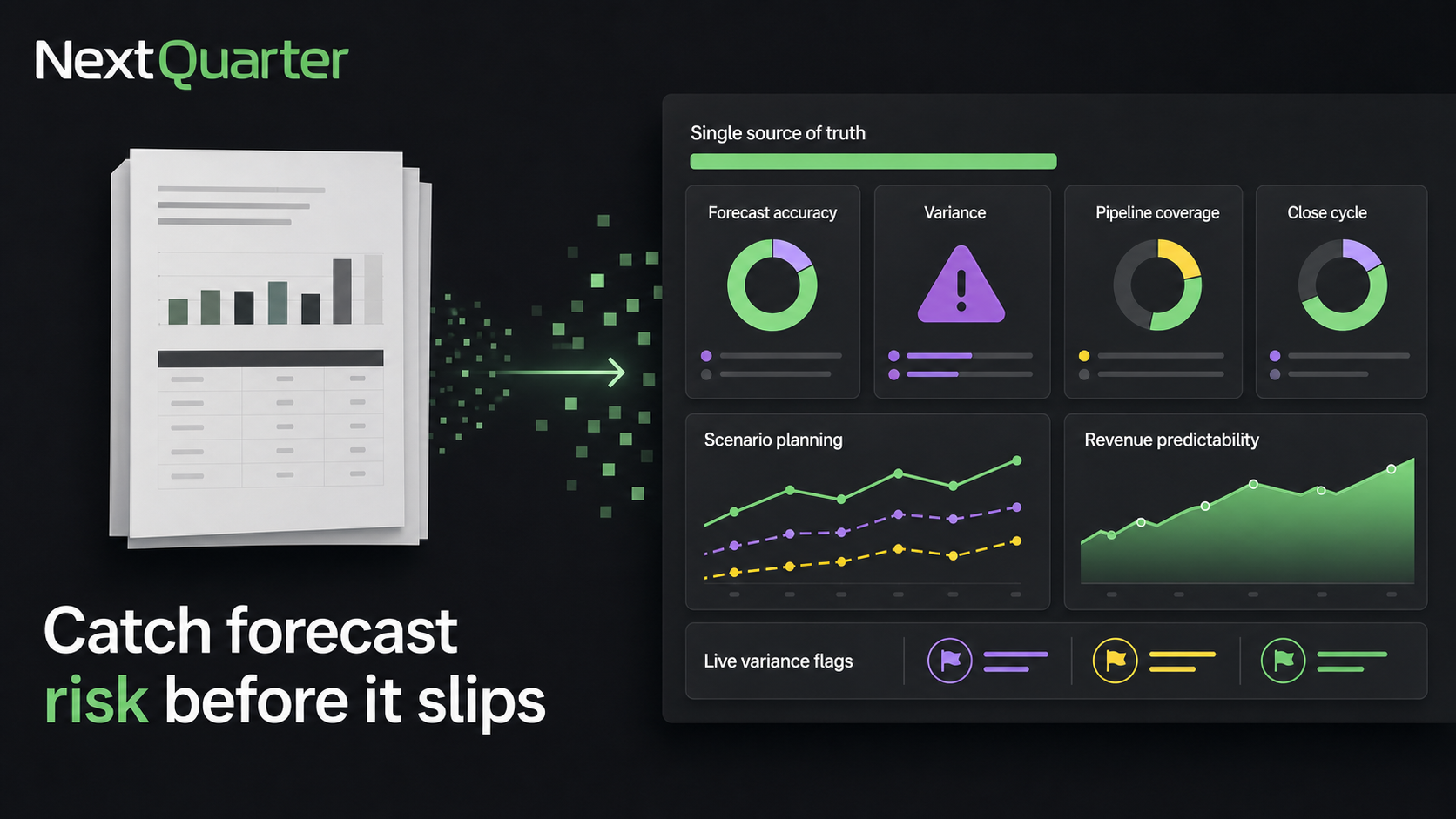
The problem is rarely a lack of effort. It is a lack of shared definitions, governed data paths, and ownership across the revenue forecast. Three gaps, and each one has a fix. Financial Agents from Next Quarter connect CRM, live pipeline, finance data, and board pack definitions into a single source of truth that every function can forecast against.
Gap One: Forecast Disagreement Starts with Definitions
When Sales and Finance disagree, the conflict looks like a number problem. It is usually a definition problem.
Sales forecasts on opportunity stage, rep judgment, close date, and commit category. Finance translates bookings into revenue timing, applies recognition logic, and adjusts for renewals, churn, and margin. Operations tracks pipeline coverage, conversion rates, and inspection hygiene. Each function is rational inside its own system. The total forecast still breaks, because none of those definitions reconcile with each other.
The break shows up in familiar ways. A late stage opportunity sits in the CRM forecast but does not map to revenue timing. Coverage looks sufficient in Sales reporting while Finance sees risk in the mix. A board pack metric uses one definition and the operating dashboard uses another. By the time anyone catches the mismatch, the forecast call has turned into a reconciliation exercise.
Financial Agents close that gap by learning the definitions before producing the answer. NQ Fin Assist, the finance intelligence inside Financial Agents, is trained on customer KPIs, definitions, data, and finance logic, so every roll up reflects the board pack rules, coverage thresholds, and bookings logic the business already reports on. One definition set, applied everywhere, settles whose version of commit counts before the meeting starts.
Gap Two: Ungoverned Data Paths Break Trust in the Number
A governed data path is a documented route from source system to reported number. Most forecasts do not have one. Figures arrive through manual extracts, offline spreadsheets, side calculations kept by a single analyst, and pasted values nobody can trace back.
The cost is trust. When a leader asks where a number came from, the honest answer is usually a person rather than a system, and reconstructing the trail takes days the quarter does not have. Every figure that cannot be explained on the spot invites a second version of the truth. Second versions multiply as the close approaches.
Financial Agents expose sources, source queries, and the SQL behind each answer. Any forecast figure can be opened and traced back to the record that produced it, inside the meeting rather than three days after it. RevOps stops mediating between competing spreadsheets and points Sales and Finance at the same governed trail.
Gap Three: Without Ownership, the Forecast Belongs to Nobody
Sales owns the commit. Finance owns revenue recognition and board readiness. RevOps owns process discipline. The consolidated number the board sees often has no single owner, because it gets assembled every quarter by whoever has the hours to spare.
Assembly work crowds out judgment. Analysts spend the final week of the quarter rebuilding a roll up instead of asking why coverage fell under threshold. Variance surfaces at the close, once the moves that could have corrected it have expired. Accountability blurs, and a missed quarter gets explained rather than prevented.
Financial Agents give the forecast a home. One governed roll up becomes the record every function reads from, and it stays current as pipeline moves, so RevOps owns a live number instead of rebuilding a static one. Variance flags fire while the quarter is still open, and scenario modeling answers close rate and timing questions in minutes. Sales still brings account context, Finance still owns revenue logic, and the number itself now has an owner and an audit trail.e, finance data, and board-pack definitions.
Forecast Disagreement Usually Starts With Definitions
When Sales and Finance disagree, the conflict often appears as a number problem. In reality, it is usually a definition problem.
Sales may be forecasting based on opportunity stage, rep judgment, close date, and commit category. Finance may be translating bookings into revenue timing, applying different recognition logic, or adjusting for renewals, churn, and margin assumptions. Operations may be tracking pipeline coverage, conversion rates, and inspection hygiene. Each function is rational inside its own system, but the total forecast becomes fragile when the definitions do not reconcile.
That fragility shows up in familiar ways. A late-stage opportunity appears in the CRM forecast but does not map cleanly to revenue timing. Pipeline coverage looks sufficient in Sales reporting, but Finance sees risk because the mix does not support the quarter. A board-pack metric uses a definition that differs from the operating dashboard. By the time leaders discover the mismatch, the meeting has become a reconciliation exercise.
RevOps leaders sit at the center of this tension. They are expected to make revenue data useful across Sales, Finance, and Operations. But without governed source trails and shared logic, RevOps becomes the function that explains why the numbers do not match rather than the function that improves revenue predictability.
Financial Agents Bring Governed Logic to the Forecast
Financial Agents are purpose-built for the forecasting and revenue-planning motion. They are not simply a chatbot attached to the close process, and they are not another dashboard waiting for a static extract. They operate across live pipeline, CRM, and finance data to roll up forecasts, reconcile signals, and surface the logic behind the answer.
A key part of that mechanism is finance KPI training. NQ Fin Assist is trained on customer KPIs, definitions, data, and finance logic so outputs align to the way the business actually reports performance. That matters because revenue organizations do not need generic answers. They need forecast roll-ups and explanations that reflect their board-pack definitions, pipeline coverage rules, bookings logic, and revenue planning model.
Governance is equally important. Next Quarter’s approach can expose sources, source queries, and SQL, allowing leaders to inspect how a forecast answer was produced. Every answer can be tied back to source data for review. For RevOps, that changes the operating posture: instead of mediating between competing spreadsheets, the team can point Sales and Finance to the same governed source of truth.
From Reconciliation Meetings to Revenue Operating Discipline
When Sales and Finance share a continuously current forecast, the meeting changes. Leaders can focus on deal movement, variance flags, pipeline sufficiency, and scenario planning instead of debating the mechanics of the number.
Consider a forecast call where pipeline coverage has fallen below the threshold needed to support the commit. In a fragmented process, Sales may argue the late-stage deals are strong while Finance questions whether enough revenue can land inside the quarter. With Financial Agents, the organization can inspect the live pipeline, connect it to finance logic, review the source trails, and model the impact of different close-rate or timing assumptions in minutes.
This does not remove judgment from the process. It gives judgment a better foundation. Sales leaders still understand account context. Finance still owns revenue logic and board readiness. RevOps still manages process discipline. But everyone is working from the same governed data layer and the same forecast language.
That is the practical path to revenue predictability. It is not achieved by forcing every team into one spreadsheet. It comes from connecting the systems they already use, training the finance intelligence on the definitions that matter, and keeping the forecast current as the quarter changes.
Take the Next Step
See how revenue organizations reach more than 97 percent forecast accuracy while cutting the manual roll up work that consumes finance at every close. Agentic roll ups, continuous variance detection, and on demand scenario modeling give Sales, Finance, and Operations one number all three can defend. Book a demo of Financial Agents and watch the quarter end scramble turn into a continuous, board ready view of where the business is headed.
Forecasting gets stronger when shared definitions, exposed sources, and clear ownership compound into one trusted operating view.