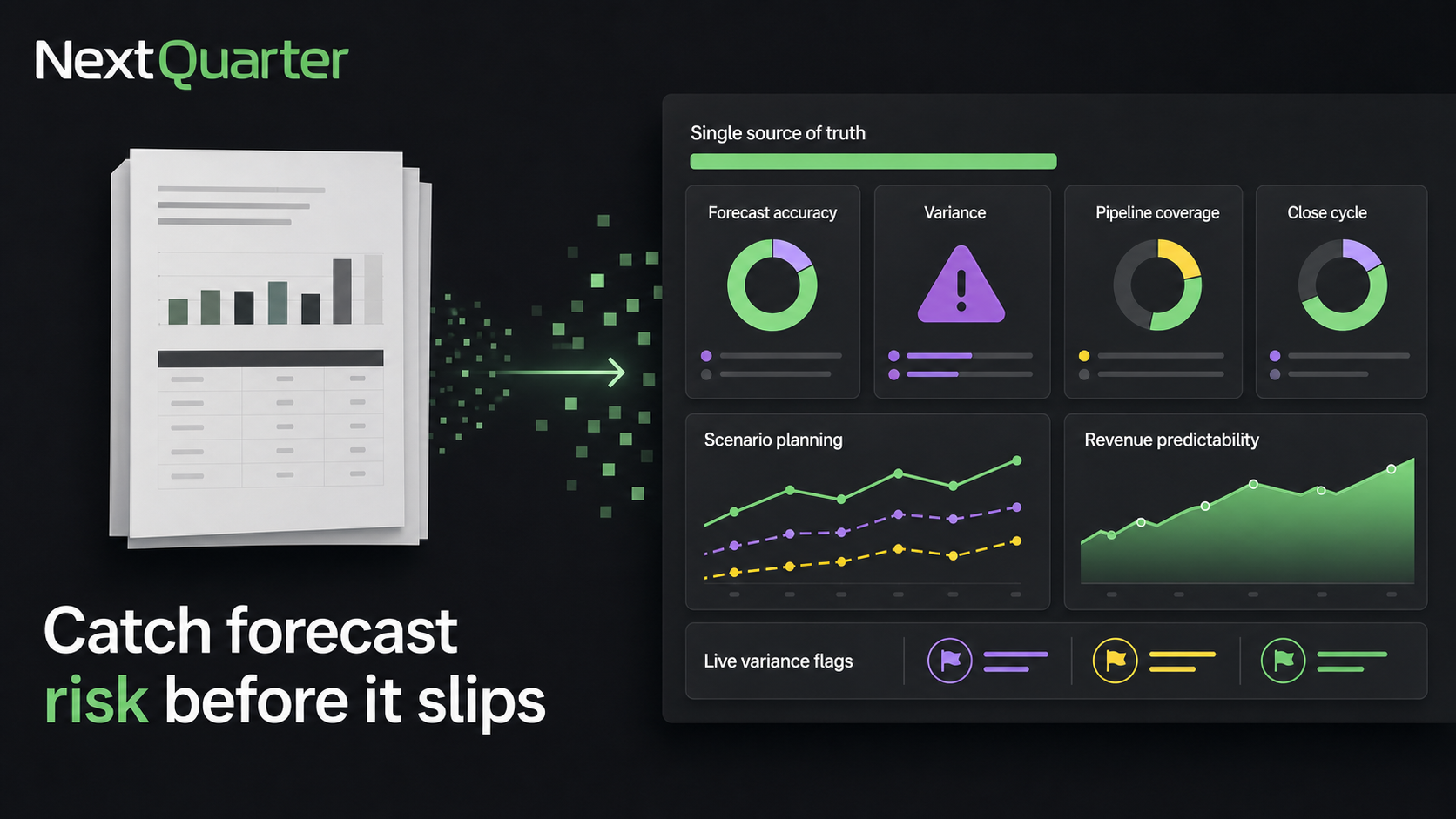
The quarter does not miss because leaders lack data; it misses because what-if answers arrive too late. An FP&A leader may have pipeline history, bookings trends, close-rate assumptions, renewal timing, and expense plans close at hand, yet still need days to rebuild a scenario when executives ask what happens if the commit slips.
That lag is where planning confidence breaks down. Financial Agents from Next Quarter turn scenario planning into an on-demand capability by using multi-agent reasoning to investigate forecast questions in parallel, synthesize decision-ready answers, and expose the sources behind the model.
Slow Scenario Modeling Creates Decision Debt
Executive forecast questions rarely arrive in a tidy planning cycle. They come in the middle of the quarter, after a large opportunity pushes, when pipeline coverage shifts, or when the board asks for a downside view. FP&A is expected to respond with precision, but the work often requires a manual rebuild.
The team updates pipeline assumptions, checks revenue timing, adjusts close rates, validates finance logic, and tests sensitivity across segments. Then the model has to be reconciled against the current forecast and translated into a narrative leaders can use. By the time the answer is ready, the decision window may have narrowed.
This creates decision debt. Leaders have the data, but not the speed to use it. They know the business is moving, but the model is locked in spreadsheet cycles. The result is either delayed action or decisions made with incomplete scenario visibility.
For FP&A, the goal is not to eliminate analytical rigor. It is to reduce the latency between a forecast question and a decision-ready answer.
Multi-Agent Reasoning Makes Scenario Planning Responsive
Financial Agents use multi-agent reasoning, where specialist agents investigate in parallel and synthesize one answer. In a forecasting context, that means different pieces of the scenario can be evaluated at the same time: live pipeline movement, pipeline coverage, close-rate assumptions, revenue timing, variance flags, and finance definitions.
NQ Fin Assist can answer plain-language finance questions with narrative, charts, risk flags, source queries, and exposed sources. That is important for FP&A because a scenario model is only useful if leaders understand both the answer and the basis for it.
Imagine an executive asks, “What happens to the quarter if late-stage enterprise close rates fall by five points and two strategic deals move into next month?” In a manual workflow, FP&A may need to refresh CRM data, adjust assumptions, rebuild revenue timing, and prepare a summary. With Financial Agents, the organization can model the scenario on demand using live pipeline and finance data, then review the narrative explanation and source trails.
The same pattern applies to upside planning. If pipeline coverage improves in a segment, leaders can ask what additional bookings or revenue timing could mean for the quarter. If churn risk appears, they can test downside exposure. If a product line is underperforming, they can model the impact on forecast and margin assumptions.
Scenario Models Are Stronger When They Share the Forecast Source of Truth
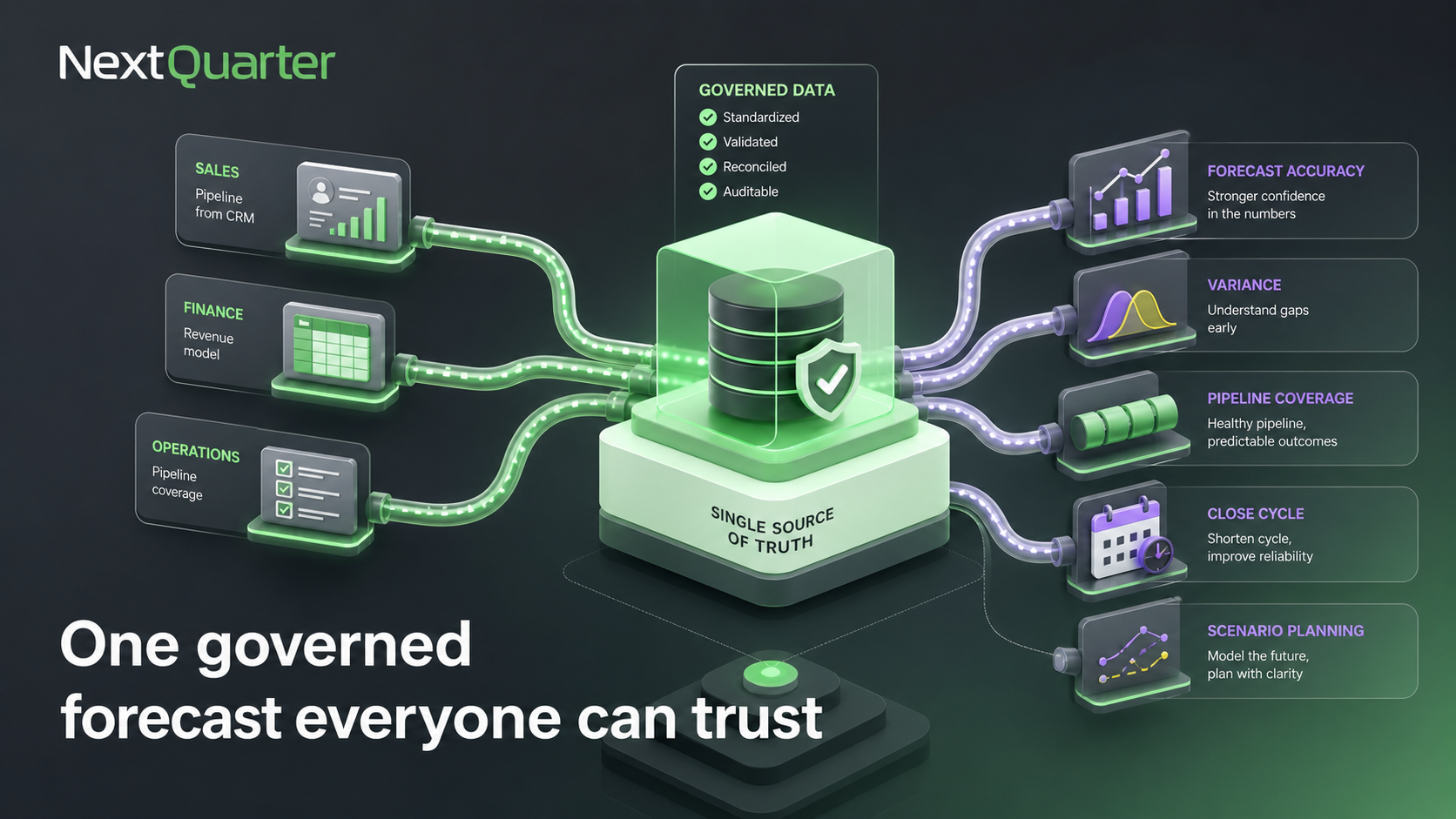
Scenario planning becomes more powerful when it is connected to the same source of truth used for forecast roll-ups and variance detection. Otherwise, the team risks creating multiple versions of the future: the official forecast, the executive scenario, the board downside case, and the spreadsheet someone rebuilt for a one-off meeting.
Financial Agents reduce that fragmentation by grounding scenarios in live pipeline and finance data. The same logic that supports the forecast can support what-if models, while exposed sources help FP&A validate the answer. This makes scenario planning more auditable and easier to operationalize.
The benefit is not just speed. It is a better management cadence. When leaders can ask and answer forecast questions in minutes, they can compare options while the options still matter. They can decide whether to increase pipeline generation, focus executive attention on specific deals, adjust expense timing, or prepare a more credible board narrative.
Next Quarter’s broader finance-agent approach is built for governed, auditable outputs for human review. That distinction matters. Financial Agents do not replace finance judgment. They give FP&A teams faster access to the connected data, finance logic, and scenario models needed to support that judgment.
Take the Next Step
See how leading revenue organizations are using Financial Agents to reach more than ninety-seven percent forecast accuracy while cutting the manual roll-up work that consumes finance every quarter close. Discover how agentic forecast roll-ups, continuous variance detection, and on-demand scenario modeling give Sales, Finance, and Operations one source of truth they can all forecast against with confidence. Book a demo of Financial Agents today and see how Gen AI finance intelligence built natively for the modern revenue motion turns the quarter-end scramble into a continuous, board-ready view of where the business is headed and what to do about it now.
Forecasting becomes a compounding source of confidence when every what-if question can become a timely, governed model for action.