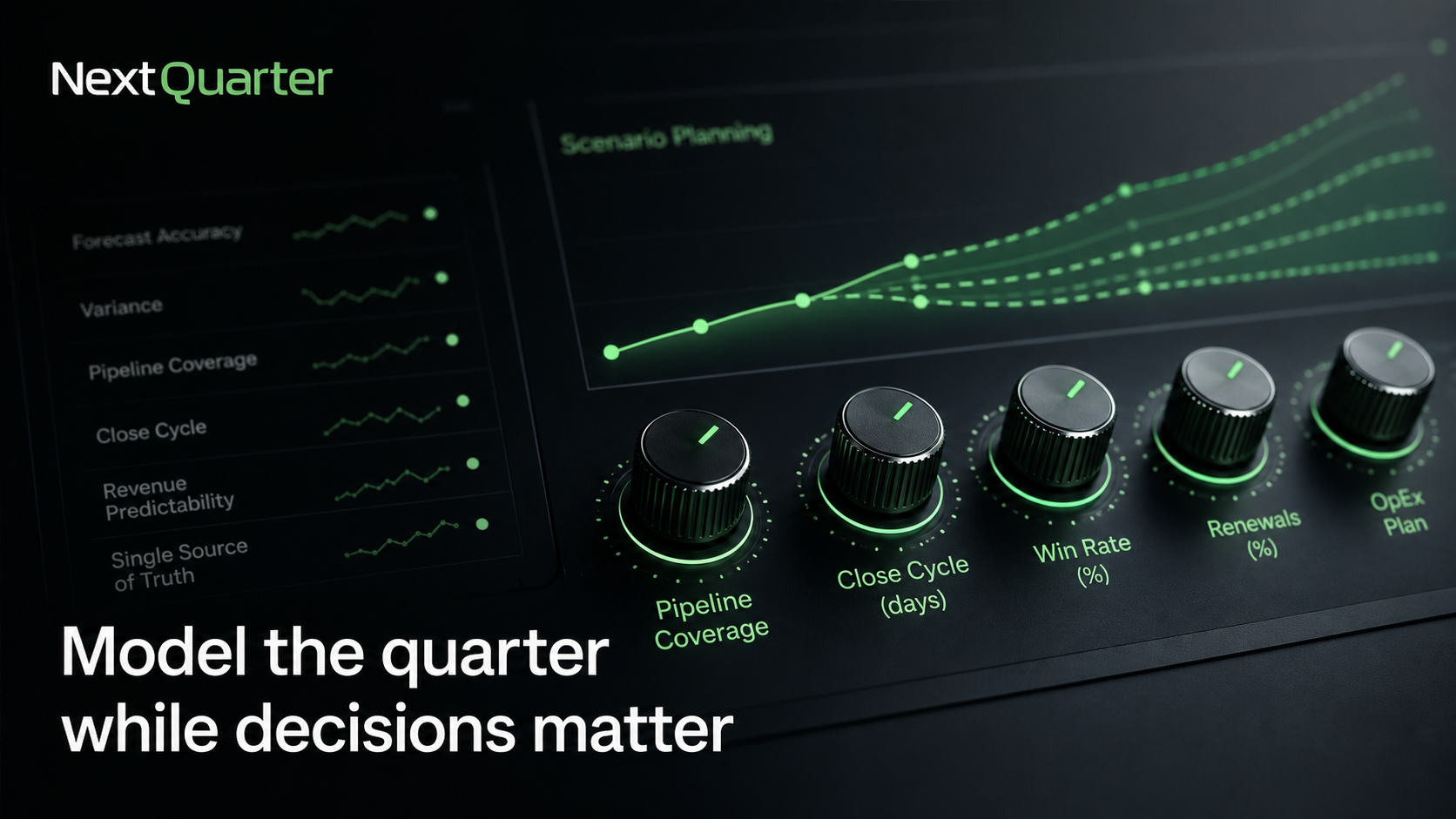
The board deck is stale the moment it is printed if variance only appears at quarter close. A Chief Revenue Officer can walk into the meeting with polished slides, clean pipeline tables, and a confident commit view, then watch the business move before the next operating review even begins.
That is the danger of static forecasting. By the time variance is visible in the deck, the quarter may already be slipping. Financial Agents from Next Quarter give revenue leaders a continuous view of forecast risk by surfacing variance flags, narrative explanations, headline metrics, and board-ready visuals as pipeline and finance data change.
Static Board Reporting Is Too Slow for Revenue Motion
Revenue organizations move daily. Deals accelerate, push, expand, shrink, and change economic terms. Pipeline coverage can look healthy at the start of the month and become fragile after two enterprise opportunities shift out. A segment can outperform plan while another quietly opens a gap. A renewal risk can turn into a revenue timing issue before it appears in the formal forecast.
The board deck is not the problem. Leaders need board-ready reporting. The problem is the preparation model behind it. When the deck is built through manual exports, spreadsheet consolidation, and last-mile slide creation, it reflects a moment in time. It may be accurate when produced, but it is not alive to the operating signals that emerge afterward.
For the CRO, that creates a credibility problem. Revenue leaders are expected to explain not only what happened, but what is likely to happen next. If variance detection comes too late, the CRO is left explaining misses after the business has already moved instead of identifying risk while there is still time to respond.
Continuous Variance Detection Changes the Cadence
Financial Agents shift variance detection from a quarter-end activity to a continuous operating capability. They monitor live pipeline and finance data, compare current signals against the forecast, and surface variance flags when risk appears.
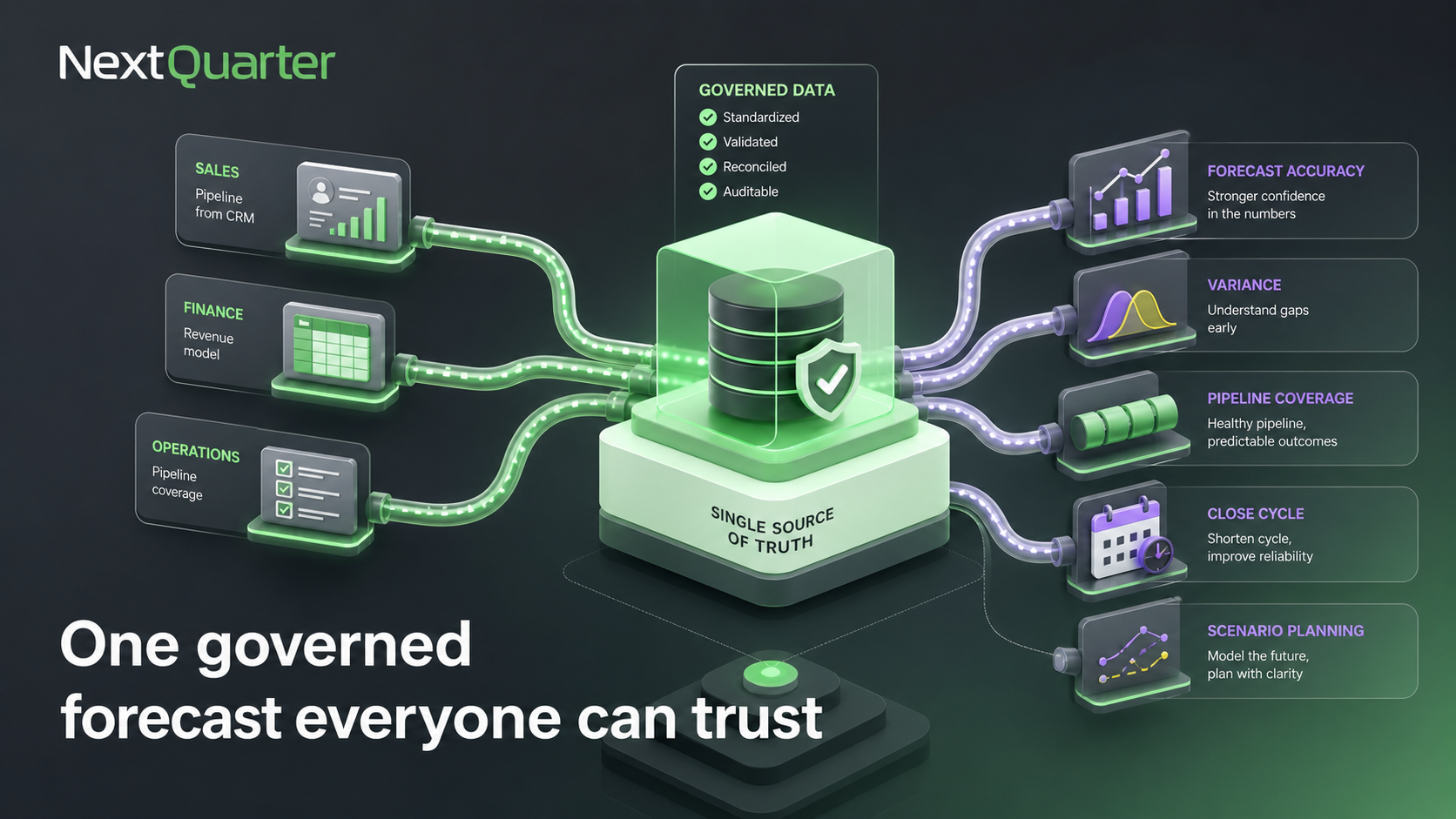
That matters because variance is rarely a single event. It is usually a pattern: pipeline coverage weakens in a key segment, close rates soften, late-stage deal velocity slows, revenue timing moves, or bookings mix changes. In a manual process, those signals are scattered across systems and meetings. Financial Agents bring them into one source of truth and connect them to the forecast roll-up.
The output is designed for executive consumption. NQ Fin Assist can produce headline metrics, narrative explanations, risk flags, charts, and board-pack-ready visuals. Instead of waiting for a static slide refresh, revenue leaders can see what changed, why it changed, and where the source data sits. That gives the CRO a clearer way to separate noise from material forecast risk.
Continuous variance detection also improves cross-functional action. Sales can inspect the deals driving the variance. Finance can assess revenue timing and forecast impact. Operations can evaluate pipeline coverage and process issues. The executive team can align on the next move before the quarter closes.
Board-Ready Does Not Have to Mean Backward-Looking
Next Quarter collateral documents a board prep cycle reduction from two weeks to two days. That result should be understood as a documented customer-observed outcome in the context of Financial Agents and related finance workflows, not as a universal guarantee. The point is larger: when finance intelligence can assemble governed metrics, explanations, and visuals from connected data, board reporting becomes less dependent on manual slide production.
For CROs, that speed is valuable because board readiness is no longer limited to the days before the meeting. A live forecast view can support weekly operating calls, executive reviews, and investor conversations with the same discipline used for formal board materials.
The strongest board conversations are not built on perfect hindsight. They are built on a clear view of current trajectory, known risks, and credible options. Financial Agents support that shift by turning live pipeline, variance flags, and finance logic into decision-ready reporting.
This is especially important when the business is near a plan threshold. A small change in close rate, discounting, or revenue timing can materially change the quarter. Waiting until the deck is finalized to discover that movement leaves leaders with fewer options. Seeing it as it emerges creates room to act.
Take the Next Step
See how leading revenue organizations are using Financial Agents to reach more than ninety-seven percent forecast accuracy while cutting the manual roll-up work that consumes finance every quarter close. Discover how agentic forecast roll-ups, continuous variance detection, and on-demand scenario modeling give Sales, Finance, and Operations one source of truth they can all forecast against with confidence. Book a demo of Financial Agents today and see how Gen AI finance intelligence built natively for the modern revenue motion turns the quarter-end scramble into a continuous, board-ready view of where the business is headed and what to do about it now.
Forecasting becomes a source of confidence when board readiness is continuous, variance is visible early, and every signal compounds into better revenue decisions.