A single flagship event routinely absorbs more than 190 hours of manual preparation — the cost nobody budgets for, and the one that produces no payback number finance will defend.
Ask a marketing leader what their flagship conference costs and the answer comes fast. The sponsorship tier, the booth build, the flights, the hotel block, the swag. All of it sits in a spreadsheet, tracked to the dollar.
Now ask how many hours the team spent getting ready for that show. The answer gets vague. A few weeks? Most of a quarter? Nobody really counts, because the work is spread across so many people and so many small tasks that it never lands on a single line.
It should. A single flagship event routinely absorbs more than 190 hours of manual preparation across a team. That is the cost nobody budgets for, and it is often larger than the line items everybody watches. Worse, all that effort tends to produce the one thing finance trusts least: a conference that gets filed under “brand spend” with no payback number attached.
Here is where those hours actually go, and what changes when the work stops being manual.
Selection: a week spent guessing
Before a single dollar gets committed, someone has to decide the event is worth attending at all. That means sorting through more shows than the team can cover, reading noisy trend signals about where buyers might be, and trying to gauge which competitors will be on the floor.
The trouble is that competitive presence usually stays invisible until a rep walks the aisle and counts three rivals with bigger booths. By then the contract is signed. So the selection work, often the better part of a week, produces a decision made on partial information and a fair amount of hope.
Targeting:the highest-value hours, spentlast and rushed
Pre-booked meetings are the strongest single driver of event return. A calendar that is full before the doors open beats a week of hoping foot traffic delivers.
Yet targeting is almost always the work that gets squeezed. The team reconciles an ideal-customer list against a guess at who will attend, because the real attendee mix is never visible early enough. Outreach gets written in the final days, sounds generic, and goes out too late to actually book anything. The hours that should produce the highest return get the least runway, and the calendar stays empty until day one.
Design and content: 20 to 30 hours of build-from-scratch
Then there is the booth and everything around it. Layout, signage, demos, brochures, slide decks, interactive elements, all of it checked against time and cost limits and revised through several rounds of feedback.
For most teams, this swallows another 20 to 30 hours of designer and coordinator time per event, and it tends to happen in parallel with the targeting crunch, which is how both end up rushed.
On site: confusing traffic with demand
The event itself feels productive because it is busy. Busy is not the same as qualified. Booth traffic gets counted as if every badge scan were a buyer. Notes and next steps get captured inconsistently, often on whatever scrap is handy.
Reps walk into conversations with uneven prep, so the quality of a meeting depends on which rep happened to take it. None of this shows up as hours on a timesheet, but it is where much of the upstream effort quietly leaks away.
Follow-up: the leak that loses the deals
The show ends and everyone goes home tired. Follow-up drifts. When it finally goes out, it sounds identical to every recipient regardless of which session they attended or which problem they named. Leads stall in handoffs between marketing and sales. Attribution turns into a debate instead of a report.
By the time anyone reaches a warm prospect, the moment has cooled. Themeetings that should have come out of the show never get booked, and the learning that would sharpen the next event never gets captured.The meetings
Add it up
Each of these is a defensible use of time on its own. Stacked across a single event, they pass 190 hours. Stacked across a year of events, they are the difference between a program that earns more budget and one that spends theoff-season justifying its existence.
And the cruel part is the output. After all that work, the return still comes down to a hallway anecdote about a good conversation at the booth. Months of effort, and no number finance will defend.
The hours were never the real problem
It would be easy to read all of this as a productivity story. Find a faster way to do the 190 hours, free up the team, move on. That misses the point.
The deeper issue is that manual prep forces a sequence that works against return. The highest-value work, deciding where to play and booking the right meetings, depends on information that arrives too late to act on. So it gets rushed at the end, while the low-impact work expands to fill the calendar.
Effort and impact end up inversely related. The team is busiest doing the things that matter least.
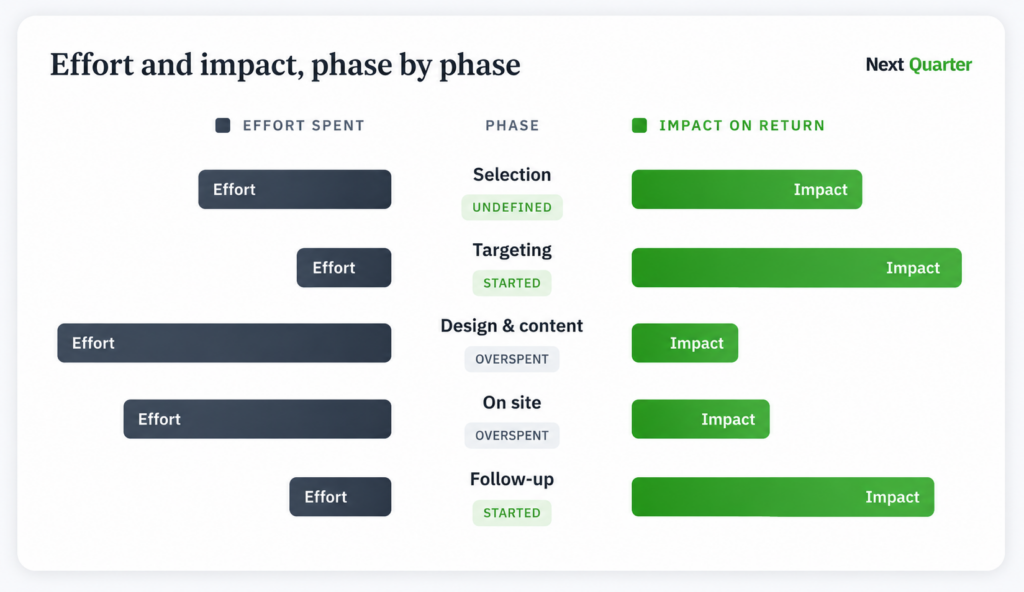
The inversion: Targeting and follow-up move return the most, yet draw the least effort. Design and on-site soak up the hours for the least return. Illustrative of the relationship described, not measured hours
The events programs pulling ahead right now are not the ones simply working faster. They are the ones that have inverted that sequence. They treat an event as a single connected motion rather than a series of disconnected scrambles, and they make the strategic decisions first, on real signal, with enough runway to act.
That shift changes what each phase even is. Selection stops being a week of guesswork and becomes a decision grounded in who will actually be in the room. Targeting moves to the front of the timeline, so calendars fill while competitors are still debating booth size. Follow-up becomes a motion measured in hours rather than a drift measured in weeks. Same lifecycle, reordered around impact.
The number that ends the brand-spend debate
The payoff is not just a lighter workload. It is a different conversation with finance.
When the strategic work happens first and gets instrumented from the start, an event produces evidence instead of anecdotes. Leading indicators (targets engaged, pre-books, show rate, time to first touch) and outcome metrics(pipeline, win rate, payback) get captured as the program runs, not reconstructed afterwards in an argument. Teams operating this way consistently report more pre-booked meetings per event, faster follow-up, and a meaningfully higher rate of turning meetings into pipeline.
More important than any single figure is what becomes possible once the figures exist. Budget can move each quarter away from the events that underperform toward the ones that produce pipeline. The program stops defending its existence in the off-season and starts compounding.
That is the moment a conference stops being “brand spend” and becomes a growth line finance is willing to protect.
Where this leaves you
The 190 hours are real whether or not anyone counts them. The honest question is not how to do them faster. It is whether the current sequence is buying outcomes or just buying activity. For most teams, it is the second one.
The teams that fix the order, deciding and engaging early and measuring throughout, are the ones turning events into a repeatable growth motion. The hardest part of making that shift is usually the measurement, because it is what convinces finance the reorder was worth it.
That is the one piece worth handing over. The Event ROI Scorecard is the one-page model used to prove event payback: the leading indicators to track before the show (targets engaged, pre-books, show rate, time to first touch) and the outcome metrics to track after (pipeline, win rate, payback period), with the formulas that tie spend to qualified pipeline.
Download the scorecard to give your next event a payback number finance will defend.